


The UK’s Top Locations for
Golden Hour Photography

That short window just after sunrise and before sunset, known as golden hour, brings softer light, longer shadows and more balanced tones, making it one of the most rewarding times to shoot.
To help you make the most of it and mark the return of longer sunlight hours, we’ve ranked the best golden hour photography spots across the UK. We’ve also included practical tips from Lizzie James, Product Specialist at Jessops, to help you get the most out of golden hour, from setting up your camera to working with the changing light.
Contents
What is golden hour photography?
Methodology
To determine the rankings, a seedlist of the UK’s most popular beauty spots, from National Trust Sites to beaches, was compiled, and each location was assessed using three key factors. These included the average length of golden hour and the total day length during Spring (sourced from Map Tools), and Instagram hashtag volume, which was used as an indicator of how often each spot is photographed and shared.
Each location was then given an overall score based on an equal weighting across all three factors. Final scores were converted into a mark out of 10, with those scoring closest to 10 ranking highest overall. Locations were then ordered from highest to lowest score to create the final top eight.
What is golden hour photography
Golden hour photography is shooting during the short window just after sunrise and just before sunset, when the sun sits low in the sky and casts a soft, warm light across the scene.
At this time of day, the light is more diffused and less harsh than the midday sun. Instead of strong overhead shadows and bright highlights, you get a gentle glow, longer shadows and a natural warmth that adds depth and atmosphere to your images.
This is why golden hour is so popular with photographers. The softer light is far more flattering for portraits, helping skin tones look more even and natural, while landscapes benefit from added texture and contrast as the light skims across surfaces.
Whether you’re capturing city streets, coastlines, or countryside views, golden hour offers a more forgiving, visually interesting light to work with, making it one of the easiest ways to instantly improve your photos.

When is the golden hour?
Golden hour isn’t the same everywhere, and in some locations it can last noticeably longer. This mostly comes down to geography, time of year and how the sun moves across the sky.
-
Latitude - One of the biggest factors is latitude. In places further north, like the UK, the sun travels across the sky at a lower angle, especially in spring and summer. This means it takes longer to rise and set, stretching out those softer lighting conditions and giving you a longer golden hour to shoot in. Even within the UK, this becomes more noticeable the further north you go, with places like Scotland often enjoying slightly longer golden hours than the south of England.
-
Season - The time of year also plays a part. Around the summer months, days are longer, and the sun’s path is more gradual, so golden hour can last much longer than it would in winter, when the sun rises and sets more quickly.
-
Landscape - Open areas like coastlines, lakes or wide countryside tend to give you uninterrupted light for longer, while cities or mountainous areas can block the sun earlier, shortening the effect as it drops behind buildings or hills.
All of this means that where and when you shoot can have a big impact on how much time you actually get. If you’re planning a golden hour session, it’s worth checking sunrise and sunset times in advance, and thinking about how the surrounding landscape might affect the light.
The best UK locations for golden hour photography
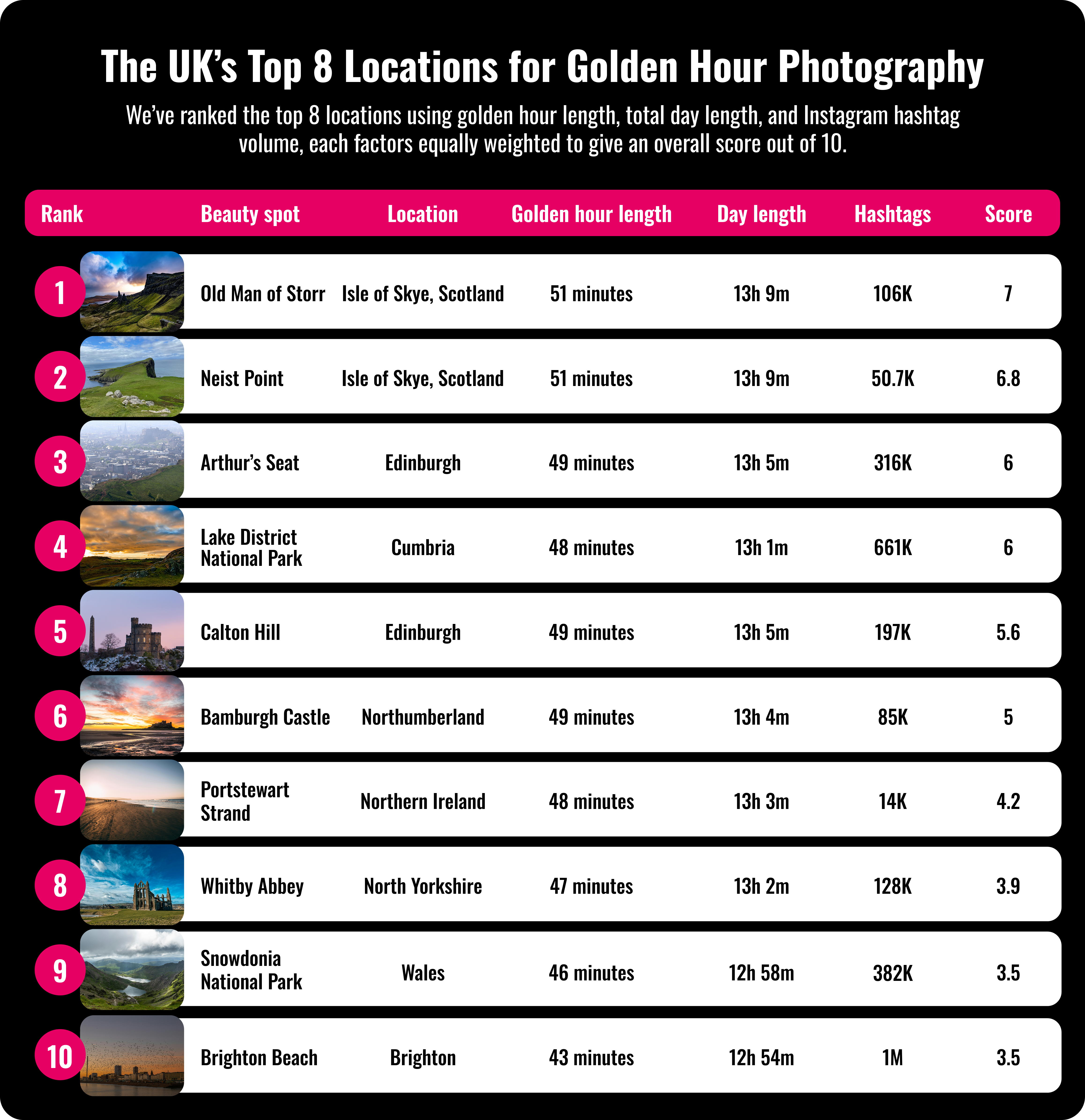
1. Old Man of Storr, Isle of Skye, Scotland (Score: 7)
Photo by Grégory Tonon on Unsplash
Taking the top spot, the Old Man of Storr on the Isle of Skye, located off Scotland’s west coast in the Inner Hebrides, stands out as one of the UK’s most striking locations for golden hour photography. With a golden hour lasting around 51 minutes during Spring, photographers have just under an hour to make the most of the changing light as it moves across the landscape.
What makes this location so compelling is how the light interacts with the rock formations. The towering pinnacle and surrounding cliffs catch the low sun beautifully, creating strong contrast, texture and depth.

As the light shifts, shadows stretch across the hillside while the rock itself takes on a warm glow, making it an ideal setting for dramatic landscape shots. On mistier mornings or evenings, that light can diffuse through the haze, adding a softer, more atmospheric feel to the scene.
It’s also one of the UK’s most popular photography spots, with over 106K Instagram hashtags, and that popularity is easy to understand. Between the unique natural formations and sweeping views, it’s a location that delivers both visually and practically for photographers looking to capture something memorable.
2. Neist Point, Isle of Skye, Scotland (Score: 6.8)
Photo by Karen Cann on Unsplash
Also located on the Isle of Skye, on the island’s westernmost edge, Neist Point is another standout Scottish location for golden hour photography. However, unlike the Old Man of Storr, Neist Point offers a different setting, swapping dramatic rock pinnacles for rugged cliffs and sweeping coastal views.
The lighthouse, perched on the edge of the cliffs, becomes a strong focal point as the sun begins to set, with warm light spilling across the headland and reflecting off the sea below. It’s a spot that works especially well for wide landscape shots, capturing both the scale of the coastline and the softness of the evening light.

3. Arthur’s Seat, Edinburgh (Score: 6)
Photo by Nadia Ramella on Unsplash
Set in the heart of Scotland’s capital, Arthur’s Seat offers a beautiful golden hour experience. Rising above Edinburgh, this ancient volcanic peak gives you a full, 360° panoramic view over the city, from the historic Old Town to the coastline beyond.
What makes it stand out is the vantage point. Instead of focusing on a single landmark, you’re capturing layers of the city as the light shifts. As the sun lowers, rooftops, streets and surrounding hills pick up a soft glow, while long shadows stretch across the landscape.
It’s also a location that rewards a bit of effort. The short hike to the top means you’re elevated above the usual street-level viewpoints, giving your images a more expansive, open feel that’s hard to replicate elsewhere in the city.

Joint 3. Lake District National Park, Cumbria (Score: 6)
Photo by Zubair Works on Unsplash
Joint third on the list, the Lake District National Park in Cumbria continues the trend of northern locations dominating the rankings. It’s known for its lakes, fells and open landscapes, offering a calm, natural setting for golden hour photography.
As the light softens, the lakes reflect the sky while the surrounding hills pick up warm tones. On still evenings, these reflections can make even simple compositions stand out.
The Lake District makes for a great weekend away, giving you the chance to explore multiple viewpoints, slow things down and make the most of golden hour across different spots.

4. Calton Hill, Edinburgh (Score: 5.6)
Photo by Nicola Gadler on Unsplash
Also in Scotland’s capital, Calton Hill offers a more accessible alternative to Arthur’s Seat, while still delivering impressive golden hour views. Just a short walk from the city centre, it’s much easier and quicker to reach, making it ideal if you’re short on time or don’t want the hike.
From the top, you can see across Edinburgh’s skyline, including clear views towards one of the UK’s most photogenic landmarks, Edinburgh Castle and the historic Old Town. As the sun sets, the city takes on a warm glow, with light catching the stone buildings and monuments dotted across the hill.

5. Bamburgh Castle, Northumberland (Score: 5)
Photo by Petr Bouda on Unsplash
Located on the Northumberland coast in the north east of England, Bamburgh Castle sits high on a rocky outcrop overlooking the North Sea, making it a natural focal point for golden hour photography.
As the sun drops, warm light catches the castle walls while the beach and water below soften the scene. The wide stretch of sand gives you space to frame the castle from different angles, whether you keep it bold and central or use the shoreline to guide the shot.
It’s a location that combines strong structure with open coastline, giving you plenty to work with as the light changes.

6. Portstewart Strand, Northern Ireland (Score: 4.2)
Photo by Simon Moore on Unsplash
Portstewart Strand in Northern Ireland is a beach with nearly 2 miles of open sand. Backed by dunes and facing uninterrupted sea views, it’s a location that feels calming and looks beautiful during golden hour.
With around 48 minutes of golden hour daily during Spring, there’s a good window to shoot as the light changes. As it softens, the wet sand reflects the sky, while subtle details like footprints, ripples and incoming waves add interest. The space also gives you the freedom to try different compositions, from simple shoreline shots to wider scenes that show the scale of the beach.

7. Whitby Abbey, North Yorkshire (Score: 3.9)
Photo by Anna Cicicic on Unsplash
Overlooking the Yorkshire coast, Whitby Abbey sits high above the town on the East Cliff, creating a strong focal point for golden hour photography with its Gothic architectural style. The ruins themselves add plenty of character, with their tall arches and weathered stone standing out against the sky.
As the sun begins to set, the abbey is often silhouetted, giving you the chance to capture bold, graphic shapes rather than detailed textures. From below, the 199 steps leading up from the town can also be used to frame the scene, adding a sense of scale and direction to your shots.

8. Snowdonia National Park, Wales (Score 3.5)
Photo by Josh Kirk on Unsplash
In North Wales, Snowdonia National Park is home to Snowdon, and the landscape is shaped by rugged mountains, deep valleys and scattered lakes. It gives photographers plenty to work with across a single landscape.
As the sun lowers, it catches the edges of the mountains and shifts quickly through the valleys, meaning conditions can change fast, but that’s part of what makes it so rewarding to shoot.

Joint 8: Brighton Beach, Brighton (Score: 3.5)
Photo by Caroline Veronez on Unsplash
Joint eighth with Snowdonia National Park, Brighton Beach is the only southern UK location in our ranking, with a score of 3.5. The beach combines a lively seafront with classic coastal views.
With around 43 minutes of golden hour daily during Spring, there’s a solid window to shoot as the light shifts along the promenade and across the water. The mix of the pier, shoreline and city backdrop gives you a range of compositions to work with, whether you’re focusing on detail or wider scenes.

Golden hour photography tips
1. Plan ahead and arrive early
Lizzie says: “Golden hour doesn’t last as long as you think, so it’s always worth getting there early. Give yourself time to look around, figure out your composition and get your camera ready.”
“It’s a good time to get your camera settings, like aperture and shutter speed, sorted. Take a few test shots so that once the light starts to shift, you can focus on shooting rather than fiddling with settings.”
2. Position for backlighting or silhouettes
“Golden hour is perfect for backlighting, so don’t always shoot with the sun behind you,” Lizzie recommends. “Try turning your subject towards the light instead, so the sun sits behind them. That’s how you get that soft glow around people, buildings or landscapes, and it can make your images feel a lot more atmospheric.”
“Just keep in mind it can be a bit tricky. Shooting into the sun can sometimes cause lens flare or make your subject look too dark, so you might need to adjust your exposure slightly or change your angle to get the balance right.”
3. Use a wide aperture for portraits
Lizzie says: “Aperture can really change how your photos look. For portraits during golden hour, it’s a good idea to use a wide aperture, which just means using a lower f-number, like f/1.8 or f/2.8.”
“What that does is blur the background, so your subject stands out more clearly. During golden hour, this works especially well because any light in the background, like the sun or reflections, turns into a soft blur rather than a distraction.”
“If you’re using aperture priority mode, you can simply dial in a lower f-number and let the camera handle the rest.”
“The main thing to watch is focus. Because you’re letting in more light, only a small part of the image will be sharp, so always make sure you focus on the eyes to keep the shot looking clean.”
4. Shoot in RAW and adjust white balance
Lizzie explains: “Golden hour light changes quickly, so what looks right in one moment can feel completely different a few minutes later. That’s why shooting in RAW is really useful, especially if you’re still getting used to your settings.”
“RAW files hold more detail than JPEGs, which means you’ve got more flexibility when you come to edit. If your photo looks a bit too cool or too orange, you can easily adjust the white balance afterwards without losing quality.”
“During golden hour, colours can shift quite a lot as the sun drops, so having that control makes a big difference. It means you’re not stuck with whatever your camera decided at the time, and you can fine-tune the look to match what you actually saw.”
5. Prepare for low light
Lizzie says: “Golden hour doesn’t last long before the light starts to drop, so it’s important to be ready for lower light conditions as you’re shooting. As the sun dips, your camera will need more light to keep your images properly exposed.”
“For beginners, the easiest adjustment is usually ISO. This camera setting controls how sensitive your camera is to light — a lower ISO, like ISO 100 or 200, means less sensitivity (good for bright conditions), while a higher ISO, like 6400, makes your image brighter in darker situations.”
“If your shot starts looking too dark, try raising your ISO gradually rather than changing everything at once. You can also lower your shutter speed to let in more light, but if you go too slow while shooting handheld, your photo can start to blur.”
“As a rough guide, if you’re photographing people or anything moving, you’ll want a faster shutter speed, like 1/250th of a second or quicker, to keep things sharp. If you’re shooting a landscape and nothing’s moving much, you can get away with a slower shutter speed, such as 1/60th. “A tripod really helps here. It keeps the camera steady in lower light, so you can use slower shutter speeds without adding camera shake.”
Make the most of golden hour with Jessops
From coastal views to mountain landscapes and city skylines, shooting during golden hour offers some of the most flattering conditions to work with. The softer light gives you the chance to experiment and capture scenes in a completely different way.
Having the right kit can make all the difference, especially as the light changes quickly. Whether it’s a camera that performs well in lower light, a lens suited to wide landscapes, or a tripod to keep things sharp as the sun dips, Jessops has you covered. And if you’re unsure what works best, our experts are always on hand to offer straightforward, practical advice.
Read our blog for more inspiration, tips and guidance, contact our friendly experts online or pop in-store to chat with the team.
Sign up for our latest news and offers
Receive the best offers right to your inbox by signing up to our newsletter
Thank You
