


The UK’s Top 10 Most
Photographed Streets

From colourful city corners to historic stretches packed with character, certain UK streets seem to live permanently on camera rolls and Instagram feeds. Whether it’s bold architecture, music history or iconic shopping landmarks, these famous streets in the UK have become favourites for tourists and photographers alike.
To find out which ones are snapped the most, we’ve ranked the UK’s top 10 most photographed streets, plus shared expert street photography tips from Lizzie James, Product Specialist at Jessops, to help you capture them at their very best.
Contents
The UK’s top 10 overall most photographed streets
The UK’s top 5 most photographed landmark streets
The UK’s top 5 most photographed historic streets
The UK’s top 5 most photographed cultural streets
The UK’s top 5 most photographed shopping streets
Methodology
The UK’s most photographed streets were identified and shortlisted based on consistent coverage in reputable travel guides, national media and official tourism websites, as well as their wider cultural and visual significance.
To determine rankings, Instagram hashtag volumes for each street were analysed. Locations were then ordered from highest to lowest hashtag count to create the final top 10 index.
The UK’s top 10 overall most photographed streets
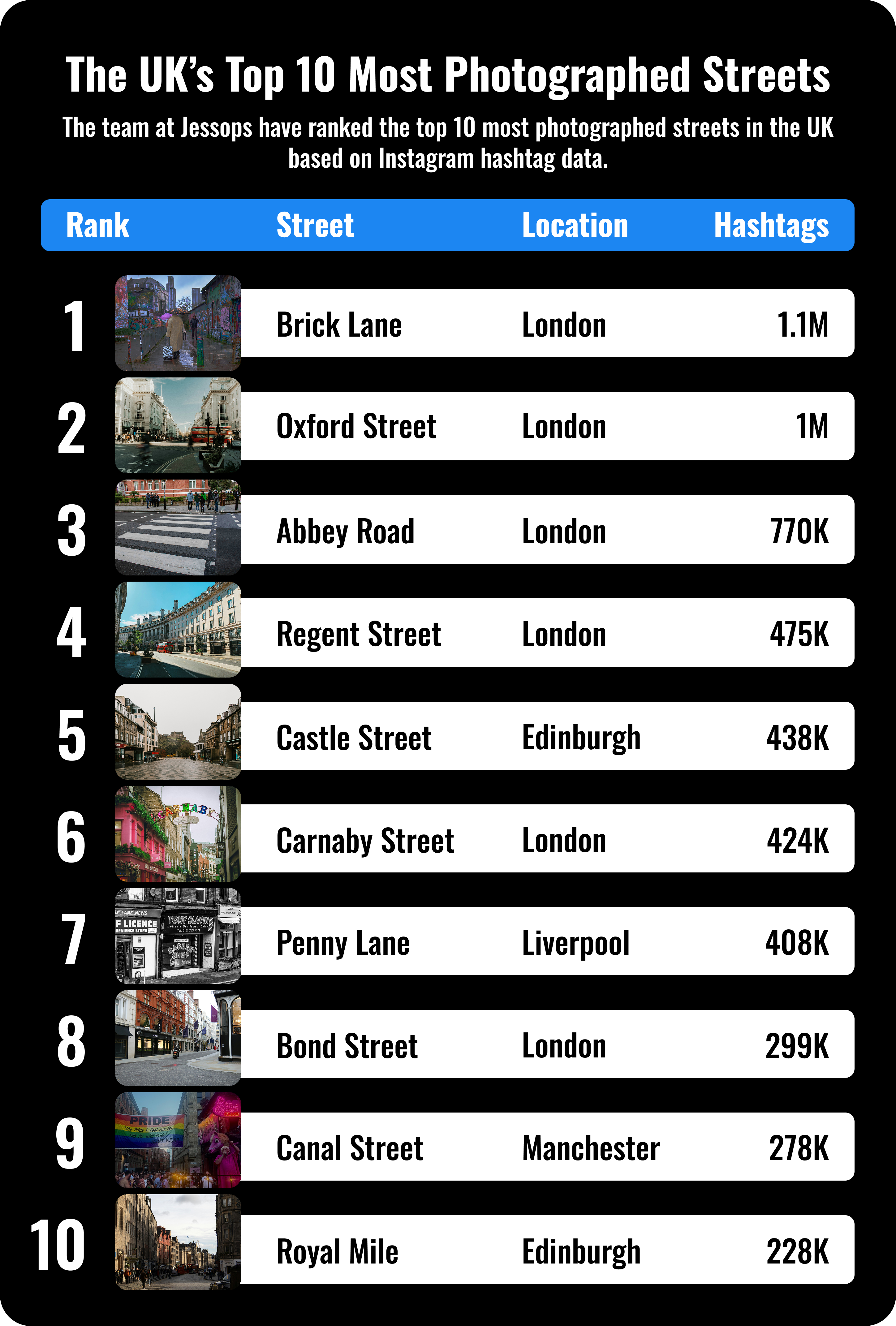
1. Brick Lane, London (1.1 million hashtags)
Photo by Flavio Vallone on Unsplash
Topping the list as the UK’s most photographed street, Brick Lane has become a favourite for photographers thanks to its constantly changing look and unmistakable character. With over 1.1 million Instagram hashtags, it’s one of those places where no two visits, or photos, ever feel the same.
What makes Brick Lane so popular is its mix of colour, culture and texture. Bold street art and murals line the walls, shopfronts are packed with personality, and vintage stores, record shops and curry houses all add to the visual chaos in the best possible way. It’s a street that feels alive, making it perfect for candid shots, detail-led photography and wide scenes full of movement.

2. Oxford Street, London (1 million hashtags)
Photo by Bryan Brittos on Unsplash
Taking second place is Oxford Street, London, known for its sheer scale, energy and constant movement. As Europe’s busiest shopping street with around 200 million visitors every year, it’s a place that never really stands still, making it especially appealing to photographers looking to capture the bustling pace of city life.
It offers a variety of scenes within a single stretch. From the sweeping junction at Oxford Circus to the long, straight lines of the road itself, there’s always something happening. Buses passing, crowds flowing between shops, lights changing, and reflections forming on wet pavements. These elements combine perfectly to create images that feel unmistakably London.

During the festive season, the Christmas lights become a major attraction in their own right, pulling in photographers keen to capture glowing displays and evening shots filled with colour and atmosphere.
3. Abbey Road, London (770K hashtags)
Photo by Emilio Geremia on Unsplash
The zebra crossing outside Abbey Road Studios is one of the most recognisable spots in the world, made famous by The Beatles and recreated by millions of visitors over the years. People come here specifically to take that photo, whether it’s a careful recreation or a quick snap on a phone.
Go early if you want fewer people, or lean into the crowds and capture the constant flow of fans crossing the road.

4. Regent Street, London (475K)
Photo by xThomas Konings on Unsplash
Regent Street stands out for its sense of scale and symmetry. The sweeping curve of the road, framed by grand historic buildings, creates a look you don’t really get anywhere else in London. That gentle bend naturally draws the eye through the frame, which is why it works so well for wide shots that show off the architecture as well as the buzz of the street below.

5. Castle Street, Edinburgh (438K)
Photo by Toa Heftiba on Unsplash
Next up in the top 10, we head to Scotland, with Castle Street in the heart of the capital. This wide, straight street offers arguably the city’s best-known view, leading your eye directly towards Edinburgh Castle at the far end — one of the most photographed landmarks in the UK.
It’s the combination of Edinburgh Castle, strong lines and the historic backdrop that keeps Castle Street firmly on people’s camera rolls.

6. Carnaby Street, London (424K)
Photo by Liza Pooor on Unsplash
Carnaby Street is one of London’s most colourful streets, and that’s exactly why people love photographing it. Tucked just off Oxford Street, it’s packed with bold shopfronts, murals and hanging signs that instantly catch your eye. There’s always something new to shoot, whether it’s a fresh piece of artwork, a pop-up installation, or just the mix of colours and textures squeezed into a short stretch of road.

7. Penny Lane, Liverpool (408K)
Photo by Phil Evenden on Unsplash
Just like Abbey Road, another location made famous by The Beatles, Penny Lane is photographed for its music history rather than its looks alone. Fans come here specifically to capture the street sign and the everyday setting behind it, drawn by the song that turned a normal road into a global landmark.
What people tend to photograph here are the details. The Penny Lane sign, nearby bus stops and familiar street corners all feature heavily, often shot in a simple, documentary way. The barbershop is another popular photo stop too, immortalised in the lyrics of the 1967 hit “Penny Lane.”

8. Bond Street, London (299K)
Photo by Euronewsweek Media on Unsplash
Bond Street has a polished, high-end feel. Lined with luxury fashion houses, jewellery stores and grand façades, it’s a street that looks sleek and put-together on camera, especially when shot straight on. The architecture is understated but elegant, which helps keep photos feeling clean and uncluttered.

9. Canal Street, Manchester (278K)
Canal Street in Manchester is one of the city’s most vibrant and recognisable streets. Located in the heart of the Gay Village, it runs alongside the Rochdale Canal, blending waterside views with buzzing bars, restaurants and rainbow-lined terraces.
By day, it has a relaxed feel, with waterside seating and colourful flags reflected in the canal. By night, it comes alive — music spills out onto the street, lights shimmer on the water, and the atmosphere shifts into something electric.

10. Royal Mile, Edinburgh (228K)
Photo by Wyatt Simpson on Unsplash
The Royal Mile is one of Edinburgh’s most recognisable streets and a natural stop for anyone with a camera. It stretches between Edinburgh Castle and the Palace of Holyroodhouse.
There’s always something happening. Performers, markets, shopfronts and tourists all add movement, while the stone architecture keeps everything feeling rooted in history.

The UK’s top 5 most photographed landmark streets
| RANK | STREET | HASHTAG |
| 1 | Abbey Road, London | 770K |
| 2 | Penny Lane, Liverpool | 408K |
| 3 | Royal Mile, Edinburgh | 228K |
| 4 | Whitehall, London | 167K |
| 5 | Princes Street, Edinburgh | 79.8K |
The UK’s top five most photographed landmark streets are all places with strong cultural or historical pull. Abbey Road takes the top spot, closely followed by Penny Lane, with both streets made famous by The Beatles and photographed as much for their stories as their surroundings.
Edinburgh features twice in the top five, with the Royal Mile and Princes Street drawing cameras thanks to their historic settings and iconic views.
The UK’s top 5 most photographed historic streets
When it comes to historic streets, the places people photograph most tend to feel like they’ve barely changed over time. Steep Hill (Upper Bail) in Lincoln tops the list of the most photographed historic streets, and it’s easy to see why. The steep climb and views across the city, with the Cathedral rising above it all, give the street a dramatic look that really stands out on camera.
Steep hills, wonky buildings, cobbles and tight lanes all play a part, giving photos of historic streets a sense of depth and texture that modern streets just don’t have. And streets like The Shambles in York are a good reminder that you definitely don’t have to head south to find some of the UK’s most characterful streets.

| RANK | STREET | HASHTAG |
| 1 | Steep Hill (Upper Bail), Lincoln | 40.3K |
| 2 | Mermaid Street, Rye | 16K |
| 3 | The Shambles, York | 10.9K |
| 4 | Fore Street, Totnes | 10.4K |
| =4 | Castle Combe High Street, Wiltshire | 10.4K |
| 5 | Ship Street, Brighton (The Lanes) | 5K |
The UK’s top 5 most photographed cultural streets
| RANK | STREET | HASHTAG |
| 1 | Brick Lane, London | 1.1M |
| 2 | Canal Street, Manchester | 278K |
| 3 | Stokes Croft, Bristol | 71.7K |
| 4 | Leith Walk, Edinburgh | 38.5K |
| 5 | Smithdown Road, Liverpool | 17.8K |
Cultural streets are usually photographed because there’s always something going on. They’re colourful and full of everyday life, from street art and posters to shopfronts, food spots, and people just passing through. Places like Brick Lane don’t feel staged or tidy, and that’s exactly what makes them interesting to photograph. You can turn a corner and get a completely different shot without really trying.
What stands out from the list is where a lot of these streets are based. Three of the top five are in the north of the UK — Canal Street in Manchester, Leith Walk, Edinburgh and Smithdown Road in Liverpool.
The UK’s top 5 most photographed shopping streets
| RANK | STREET | HASHTAG |
| 1 | Oxford Street, London | 1M |
| 2 | Regent Street, London | 475K |
| 3 | Carnaby Street, London | 424K |
| 4 | Bond Street, London | 299K |
| 5 | Deansgate, Manchester | 109K |
When it comes to shopping streets, it’s no surprise that London dominates the list, with Oxford Street, Regent Street, Carnaby Street and Bond Street all making the top five.
They’re photographed not just for the shops themselves but for the atmosphere around them, from the scale and constant flow of Oxford Street to the curved architecture of Regent Street and the colour and personality packed into Carnaby Street.
Only one street sits outside the capital. Deansgate in Manchester holds its own alongside London’s shopping streets, lined with a mix of high-street favourites, department stores and independent shops, all set among trams, modern buildings and older architecture.
The UK’s top 5 most photographed steep streets
| RANK | STREET | HASHTAG |
| 1 | Castle Street, London | 438K |
| 2 | Carlton Hill Approaches, Edinburgh | 197K |
| 3 | Steel Hill (Upper Bail), Lincoln | 40.3K |
| 4 | Upper Street Viewpoint, Rye | 34.3K |
| 5 | Constitution Hill, London | 22K |
Steep streets clearly make an impression on camera, and Edinburgh really stands out here. Castle Hill and the approaches to Calton Hill take the top two spots, both rising up from central Edinburgh and photographed heavily for their height, drama and wide views over the city. When streets climb quickly, they naturally give photos depth, with long sightlines, rising buildings and views that feel earned once you reach the top.
Beyond Edinburgh, places like Steep Hill in Lincoln and the upper viewpoints in Rye show the same pattern. A sharp incline, uneven surfaces and a clear view at the end all help turn an ordinary street into something more striking on camera.
Street photography tips
1. Leverage light and shadows
Lizzie says: “Street photography isn’t just about what’s in front of you, it’s about how the light hits it. Early morning and late afternoon are ideal because the light sits lower, creating longer shadows and more texture across pavements and buildings. That contrast can add real depth and drama to a scene.”
“If the light is softer — like on an overcast day — you’ll get more even skin tones and cleaner detail, which works well for closer, more intimate shots.”
2. Prepare your camera settings
Lizzie says: “Street moments often don’t wait for you to adjust your camera settings, so it’s worth getting everything dialled in before you start walking.”
“If you’re new to street photography, aperture priority (A or Av mode) is a great place to begin. Set your aperture around f/5.6 to f/8 to keep enough of the scene in focus, and let the camera handle shutter speed for you. Keep your ISO on Auto, but set a maximum limit you’re comfortable with (for example, ISO 3200) so your images don’t get too grainy in lower light.”
“If you’re more confident, manual mode gives you more control. Start with a shutter speed of at least 1/250th of a second to freeze people walking past, then adjust your aperture and ISO to suit the light.”
Lizzie adds: “The key is to have a baseline in mind. If you already know what settings work in bright sun versus overcast conditions, you won’t miss the moment because you’re looking down at your camera. It means you can focus on timing, framing and what’s unfolding in front of you.”
To learn more, read our blog on A Beginner’s Guide to Camera Settings.
3. Choose a shutter speed that freezes real life
“Movement is often a big part of street photography, so shutter speed really matters,” explains Lizzie. “If you want to freeze people mid-step or capture natural expressions without blur, start at around 1/250th of a second. That’s usually fast enough to keep walking subjects sharp.”
In simple terms, the higher the shutter speed (like 1/500th or 1/1000th of a second), the more it freezes motion. This is useful on busy streets where people, cyclists or cars are moving quickly.
On the other hand, a lower shutter speed (like 1/60th or 1/30th of a second) lets more light in but introduces motion blur. That can be intentional, for example, blurring passing traffic while keeping buildings sharp to show energy and movement.
Just keep in mind that slower shutter speeds can also introduce camera shake, especially if you’re shooting handheld. Using a tripod or placing your camera on a stable surface can help keep buildings and static elements sharp.
“There’s no single ‘correct’ setting,” Lizzie adds. “Just decide what you want the photo to feel like. If you want crisp, frozen moments, go faster. If you want a sense of pace and motion, slow it down slightly and see what happens.”
Read our Beginner’s Guide to Shutter Speed to learn more.
4. Get closer
Some of the most powerful street photos happen when you step into the scene rather than observing from across the road. “Distance can sometimes make an image feel detached,” says Lizzie. “When you move closer, you capture expressions, gestures and small details that bring the frame to life.”
“For example, instead of photographing a busy market from the pavement opposite, step in closer to a stall and focus on hands exchanging money, steam rising from food, or someone laughing mid-conversation. Those details instantly make the image feel more immersive.”
A wider lens — around 24mm or 35mm on a full-frame camera (roughly 16mm–24mm on APS-C) — lets you stand physically closer to your subject while still fitting plenty into the frame. That means you can capture a person and the street around them without needing to step back.
“Wide lenses show more of the scene,” Lizzie explains. “Because you’re closer, the viewer feels closer too. You get the subject, the background and the atmosphere all in one shot with this lens.”
It’s also important to stay respectful and remember photo etiquette. Be aware of local rules around photographing people in public spaces, and use common sense — if someone looks uncomfortable, always ask for permission.
5. Use composition and geometry
“Street scenes can look chaotic at first glance,” says Lizzie, “However, there’s usually structure hiding in plain sight. Instead of trying to capture everything, slow down and look for shapes and lines that organise the frame for you. Road markings, building edges, window grids, railings, crossings and even shadows can all act as natural guides for the eye.”
“If you spot repetition, like a row of windows or lamp posts, use it,” she adds. “Then wait for someone to walk into that structure. Curves in a road can lead the viewer through the image, while strong verticals and horizontals help balance busy scenes.”
Geometry gives your photo a foundation, so even when there’s movement and noise, the image still feels intentional rather than accidental.
Improve your street photography with Jessops
Now you’ve seen which streets across the UK are getting the most attention, the next step is heading out and capturing them your way. Whether you’re drawn to bold city scenes, quiet historic corners or fast-paced shopping streets, the right setup makes all the difference.
From lightweight cameras that won’t slow you down to versatile lenses perfect for wide street scenes, Jessops has the gear to help you shoot with confidence. Not sure which settings or kit suit your style? Our experts are always on hand with practical advice to help you get the shot.
For more inspiration, tips and real-world photography guidance, explore our blog, contact our friendly experts online or pop in-store to chat with the team.
Sign up for our latest news and offers
Receive the best offers right to your inbox by signing up to our newsletter
Thank You
