


The UK’s Top 10 most
scenic winter destinations

From snow-covered peaks in the Lake District to festive light trails at Blenheim Palace, the UK is packed with incredible places to explore in winter. There’s no shortage of stunning spots to visit — and even more reasons to bring your camera along.
We’ve rounded up the top 10 most scenic winter attractions across the UK, plus expert winter photography tips from Lizzie James, Product Specialist here at Jessops, to help you capture them at their best.
Contents
Methodology
The team at Jessops collated a list of popular winter getaways and attractions across the UK using tourism websites. By analysing the number of Instagram hashtags linked to each location, we’ve identified which destinations are the most photographed and scenic to visit this winter.
The top 10 most scenic winter attractions in the UK
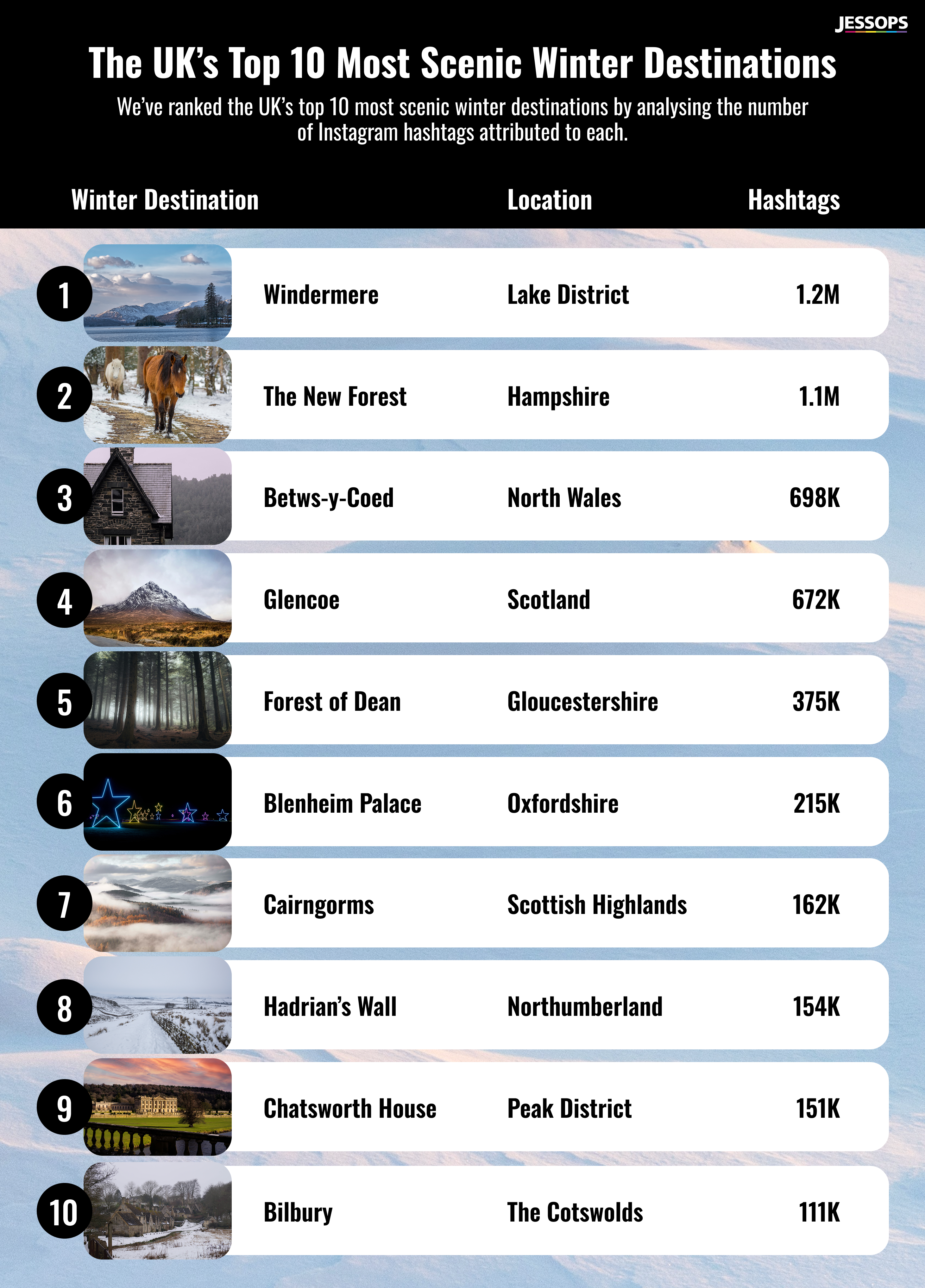
1. Windermere, Lake District (1.2M hashtags)
One of the UK’s most popular summer destinations, Windermere in the Lake District transforms into a peaceful winter escape once the crowds fade. The stillness of the lake, framed by snow-dusted hills and misty valleys, makes it the most scenic spot in the country for winter photography.
It’s also a great place for families, with gentle slopes perfect for sledging if you’re lucky with snow, and open spaces where kids can build snowmen before warming up with a hot chocolate in one of the lakeside cafes.

Photographers will find plenty to capture, from early morning mist over the water to reflections of frosty trees along the shoreline. For the best views, try Orrest Head or Claife Heights, where you can see the full stretch of the lake.
Lizzie recommends: “Use a polarising filter when photographing the lake to cut through glare and make reflections clearer. It helps bring out the contrast between the cool tones of the water and the light in the sky.”
2. The New Forest, Hampshire (1.1M hashtags)
The New Forest is a peaceful escape in winter, when the woodland takes on a calm, atmospheric feel. Low light filters through the bare trees, and early morning frost adds texture to the bracken and open heathland. Perfect for capturing those soft, moody shots.
Winter is an excellent time of year for birdwatching, with plenty of species to spot among the trees and along the waterways with your binoculars. You’ll also often see New Forest ponies, donkeys, and deer roaming freely, making it a great location for wildlife photography. And with some of the darkest skies in the south-east, it’s a fantastic place for stargazing and experimenting with astrophotography too.
To learn the best places to view the night sky, take a look at our guide on The UK’s Top 10 Stargazing Spots.

3. Betws-y-Coed, Snowdonia National Park, North Wales (698K hashtags)
Surrounded by mountains, forests, and rivers, Betws-y-Coed is one of the most picturesque places in the UK, and in winter, it’s even more magical. The village sits at the heart of Snowdonia National Park, where stone cottages and riverside paths take on a cosy, festive feel. With warm lights glowing from cafes, and the sound of the River Llugwy running through the centre, it has a peaceful, storybook charm that’s hard to find elsewhere.
Swallow Falls, just a short walk away, is particularly striking at this time of year, with icy edges and roaring water creating dramatic photo opportunities. Plus, the nearby Gwydir Forest Trails are perfect for winter walks, offering peaceful paths through pine woodland and sweeping views across the Conwy Valley.

Lizzie says: “For moving water like Swallow Falls, use a slow shutter speed and a tripod to create that smooth, silky effect. Around half a second is usually ideal.”
“You’ll need to keep your camera steady, so a tripod is essential, and using a neutral density filter can help reduce the light entering the lens for a longer exposure. It’s a great technique for adding a sense of motion and atmosphere to your winter landscapes, especially when the surrounding rocks and trees are dusted with cold, winter frost.”
4. Glencoe, Scotland (672K hashtags)
Glencoe is one of Scotland’s most dramatic landscapes, especially in winter. The towering peaks and deep valleys are often blanketed in snow, transforming the glen into a scene that looks straight out of a film.
It’s a brilliant winter destination for anyone who loves the outdoors, with peaceful hiking trails, scenic drives, and cosy cafes or pubs to warm up in after a day exploring.
Early mornings are best for photography, when the air is still and the soft light brings out every frosty detail in the landscape. The ever-changing weather adds to its atmosphere, too; one moment, bright sunlight will catch the snow-capped summits, and the next, mist will roll through the valley for a moody, cinematic feel.

It’s also common for waterfalls to freeze over in the colder months, and still lochs, like Loch Achtriochtan, offer incredible reflections and close-up textures to capture.
5. Forest of Dean, Gloucestershire (375K hashtags)
Winter brings a quieter, almost mysterious side to the Forest of Dean. The ancient woodland transforms as frost gathers on the branches and soft fog settles between the trees, creating the perfect setting for a winter walk or some creative photography.
At viewpoints like Symonds Yat Rock, you’ll often see mist rolling over the Wye Valley below, a striking sight that looks incredible through the lens. It’s also one of the best times of year to spot wildlife, with deer and wild boar more visible against the bare trees.
To discover more great spots for wildlife photography, check out our guide to The Top 10 UK Locations for Capturing Wildlife.

6. Blenheim Palace (Winter Light Trail), Oxfordshire (215K hashtags)
Unlike the Lake District or Snowdonia, Blenheim Palace offers a more festive, man-made beauty. Each winter, its grounds are transformed by the Winter Light Trail, a spectacular display of lights, projections, and seasonal installations that wind through the gardens and along the lake.
It’s a perfect spot for families and photographers alike, with glowing tunnels, illuminated fountains, and reflections shimmering across the water. The palace itself provides a stunning backdrop, especially when captured at dusk as the lights begin to glow. It’s ideal for a winter day trip or a relaxed weekend break in nearby Woodstock or Oxford.

Lizzie gives us her top tip for photographing light displays: “It’s best to switch to manual mode and lower your ISO, around 100 to 400, to keep your images clean and avoid bright lights looking too harsh or washed out. A slower shutter speed will help capture the full glow and colour of the lights. Just remember to bring a tripod to keep your shots steady and sharp.”
To learn more about the ISO setting, read our Guide to ISO for Beginners.
7. Cairngorms National Park, Highlands of Scotland (162K hashtags)
The Cairngorms National Park is one of the most picturesque places in the UK during winter. Stretching across the Scottish Highlands, it’s one of the few areas where you can almost guarantee snow, turning its mountains, forests, and lochs into a true winter wonderland.
It’s a great destination for adventure and photography. The snow-covered peaks, frozen lochs, and ancient pine forests create dramatic scenes that look incredible through the lens. You’ll also find Scotland’s top ski areas here, including Cairngorm Mountain, where you can ski, snowboard, or simply enjoy the views from the slopes.
Nearby towns like Aviemore and Braemar add to the charm, offering cosy lodges, pubs, and cafes to warm up in after a day outdoors.

8. Hadrian’s Wall and Northumberland National Park, Northumberland (154K hashtags)
With frost-covered hills, open skies, and far fewer visitors, Hadrian’s Wall is one of the most peaceful and photogenic winter spots in the UK. The wall winds through Northumberland National Park, where snow often settles on the rolling hills and stone ruins, creating striking contrasts against the dramatic landscape.
For photographers, the mix of history and natural scenery makes it a standout winter location. Sunrise and sunset are the best times to capture the soft light hitting the frosty stones. However, it’s not just in winter that Hadrian’s Wall stands out; it also featured in our top five most photogenic landmarks in Northern England, proving its appeal all year round.

Nearby, you can warm up in local pubs or explore the market towns of Hexham and Haltwhistle, both great bases for winter walks along the wall.
Lizzie says: “When photographing Hadrian’s Wall or the surrounding hills, look for leading lines, such as the wall itself or a winding path, to naturally draw the viewer’s eye through the frame. Try positioning the line so it starts near the bottom of your frame and leads towards your main subject. Shooting from a lower angle can also help show the scale of the wall against the sky.”
9. Chatsworth House in Winter, Peak District (151K hashtags)
Few places capture the charm of a classic English winter quite like Chatsworth House. Surrounded by parkland, woodland, and the River Derwent, the stately home looks striking against the muted tones of the Peak District landscape. When frost settles on the grounds or snow dusts the roof, it becomes one of the most photogenic spots in the region.
During the festive season, the house is decorated with themed displays and glowing lights, while the gardens and trails offer peaceful winter walks with sweeping views across the estate. It’s ideal for a winter day out with a camera in hand!

10. Bibury, The Cotswolds (111K hashtags)
Taking the final spot in our top 10, Bibury is often described as one of England’s prettiest villages. In winter, the honey-coloured stone cottages of Arlington Row look like something from a picturesque postcard, especially when covered in frost or dusted with a light layer of snow.
The River Coln runs through the village, and on cold mornings you’ll often see mist rising from the water, creating a calm, atmospheric scene that’s perfect for photography. With its quiet lanes, cosy pubs, and traditional tearooms, Bibury makes a great stop for a peaceful winter day out in the Cotswolds.

Tips for taking photographs of scenic winter landscapes
Here are our top winter photography tips:
1. Expose the snow properly
“Snow can often confuse your camera’s light meter, making it look dull or grey instead of bright white,” explains Lizzie. “To fix this, use your camera’s exposure compensation setting (look for a ± button) and increase it slightly — around +0.3 to +1.0 EV. This tells the camera to let in more light, keeping the snow bright and crisp while maintaining detail. If you’re shooting in manual mode, you can achieve the same effect by slightly slowing your shutter speed or widening your aperture.”

2. Shoot during golden or blue hour
“Lighting makes a huge difference to your winter photos,” says Lizzie. “Try to shoot during golden hour (around sunrise or sunset), when the light is soft and warm, giving snow and landscapes a gentle glow.”
“If you prefer something a little more atmospheric and moodier, head out during blue hour, the short time just before sunrise or after sunset, when the sky turns a deep blue and shadows create a magical feel. I'd avoid harsh midday light, as it can flatten your images and wash out detail.”

3. Look for contrast and pops of colour
Lizzie says: “Winter scenes can sometimes look flat, so adding contrast or colour makes your photos more eye-catching. Look out for bright coats, colourful scarves, red berries, or dark tree trunks that stand out against the snow. Including a small burst of colour in your photo helps catch the viewer’s eye and makes the image feel more lively and balanced.”
“For example, if you were photographing Lake Windermere, a bright rowing boat or a person holding a colourful umbrella can add a striking focal point against the muted tones of the water and surrounding hills.”

4. Capture frost, ice and texture
“Some of the best winter photos come from the small details,” says Lizzie. “Macro photography is your best friend here — it’s all about getting close to your subject to show off the fine textures and patterns that you can’t see from a distance. Try focusing on frosted leaves, icy branches, frozen puddles, or patterns on glass.”
“If your camera has a macro mode, switch it on. It’s usually marked with a small flower icon, and this helps your lens focus properly when you’re very close to your subject. If not, you can achieve a similar effect by using a wide aperture (around f/2.8–f/4) to keep your subject sharp while softly blurring the background. This makes the details, like the edges of ice crystals or the grain of a leaf, really stand out.”

5. Add a human element
Lizzie says: “Including people in your winter landscapes helps bring your photos to life. It gives a sense of scale, showing how big the landscape really is, and adds a human story to your shot.”
“Try photographing someone walking through the snow, wrapped in a bright coat, or standing in the distance looking out over the view. It instantly makes the image feel more real and engaging, as if the viewer could step right into the scene themselves.”

Capture stunning images on your next trip with Jessops
Whether you’re going on a family adventure to Cairngorms National Park or exploring the history of Hadrian’s Wall, the UK is full of beautiful winter attractions to discover.
To get ready for your next trip, Jessops has everything you need to make the most of your winter photography — from digital cameras and lenses to video cameras and drones, whatever you’re shooting.
For more advice and ideas, take a look at our blog. Or if you’re unsure which product is right for you, contact us today.
Sign up for our latest news and offers
Receive the best offers right to your inbox by signing up to our newsletter
Thank You
