


Mirrorless Camera Buying Guide
What Is the Best Option for You?

Photography is ever-evolving, and mirrorless cameras are becoming a go-to choice for professionals and enthusiasts alike, with big names like Nikon, Canon, Sony, and Fujifilm consistently unveiling advanced mirrorless models.
Whether you're considering making the switch from DSLR or simply curious about the buzz, we'll break down what a mirrorless camera is, how it works, and highlight the benefits. We'll also offer the best mirrorless camera recommendations with help from our Product Specialist, Lizzie James, at Jessops.
Contents
What is the difference between mirrorless and DSLR cameras?
What are the benefits of using a mirrorless camera?
The best mirrorless camera recommendations
Best budget-friendly mirrorless camera
Best mirrorless camera for beginners
Best mirrorless camera for video
Best mirrorless camera for sports, wildlife or action photography
Best mirrorless camera for landscape photography
Best mirrorless camera for street photography
Best mirrorless camera for low-light
Best mirrorless camera for lens options
Best compact mirrorless camera for travel
What is a mirrorless camera?
A mirrorless camera is a type of digital camera that works without a mirror inside the camera body — as you may have guessed!
Instead of using a mirror to bounce the image into your viewfinder, as a Digital Single-Lens Reflex (DSLR) camera does, a mirrorless camera sends the image straight to a digital screen or electronic viewfinder. This lets you adjust your settings and preview the image before you take your shot.
Many mirrorless cameras also offer features such as silent shooting, fast burst speeds, enhanced autofocus (AF), and excellent video performance, making them a brilliant choice for everyone from beginners and travel photographers to content creators and professionals.
What is the difference between mirrorless and DSLR cameras?
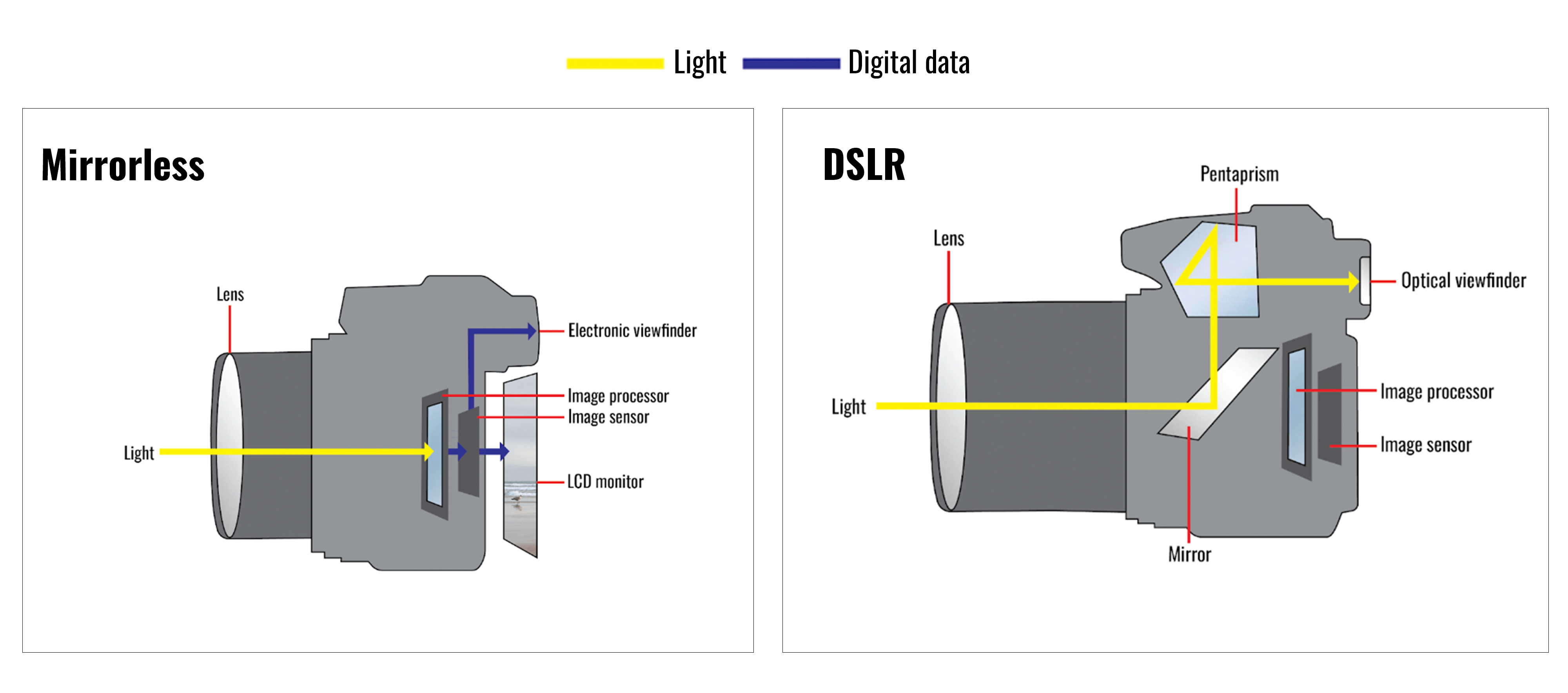
A DSLR camera uses a mirror inside the camera body to reflect light from the lens up into an optical viewfinder. This lets you see what the lens is capturing in real time, even when the camera is turned off.
In a mirrorless camera, there’s no mirror mechanism. Instead, light passes directly through the lens to a digital image sensor, which then displays a live preview on the rear screen or through an electronic viewfinder.
Because mirrorless cameras don’t need space for a mirror and optical viewfinder system, they’re often lighter, slimmer, and easier to carry than their hefty DSLR counterparts.
What are the benefits of using a mirrorless camera?
See the image change in real-time
One of the biggest benefits of a mirrorless camera is its electronic viewfinder (EVF). Unlike an optical viewfinder, an EVF shows a digital preview of what your camera sees, so you can see how your shot will look before you press the shutter.
As you adjust settings like shutter speed, aperture, ISO, or white balance, the preview updates in real time. This makes it much easier to judge exposure, depth of field, and colour, helping you feel more confident that you’ve got the shot you want.
It’s especially useful in tricky lighting conditions. If you’re shooting somewhere dark, you can increase the brightness of the display to see your subject more clearly. Or, if you’re shooting in black and white, you can set the viewfinder to show your scene in monochrome, helping you focus on light, shadow, and composition without the distraction of colour.
In short, the EVF helps take some of the guesswork out of photography, showing you what you’re likely to capture before you actually take the photo.
Silent shooting
With fewer moving parts, many mirrorless cameras offer a silent shooting mode, letting you capture images with little to no shutter sound.
This is especially useful when you need to stay discreet. If you’re photographing wildlife, for example, silent shooting can help you avoid startling your subject. It’s also great for street photography, weddings, or quiet settings where you want to capture natural moments without drawing attention to yourself.
By removing the sound of the mirror mechanism, mirrorless cameras make it easier to shoot quietly, confidently and unobtrusively.
Augmented reality
Another benefit of viewing your shot on a digital screen or electronic viewfinder is that you can display helpful shooting information over the top of your image.
This could include grid lines to help you line up your composition, a live histogram to check exposure, or focus peaking to highlight the areas that are sharp. These tools make it easier to fine-tune your shot as you’re taking it, rather than having to review and adjust afterwards.
Some mirrorless cameras also let you preview creative effects in the EVF, such as black-and-white modes or multiple-exposure shots. With multiple exposure, each frame can be added to the view as you shoot, helping you see how the images are coming together and giving you a better idea of what the final combined photo will look like.
Improved autofocus (manual focusing is easier, too)
Autofocus points are specific spots in the camera's viewfinder that it can use to focus on a subject. And, since there's no mirror in the way, mirrorless cameras offer many more focus points than a DSLR, running closer to the edges of the digital screen.
This makes tracking easier, too; with more focus points, your camera can follow moving people or animals, keeping them sharp.
Even if your subject is briefly obscured (for example, if it walks behind a tree), the camera's focus system is smart enough to predict where it will reappear, maintaining focus. This gives you a clearer shot of fast-moving subjects, capturing the action without a blur.
Manual focusing is also easier. To check you've got it spot on, you can increase the magnification in the EVF and zoom right into your scene, guaranteeing pin-sharp focusing exactly where you want it.
Faster burst speeds
Mirrorless cameras are brilliant for capturing fast-moving action, thanks to their impressive continuous shooting speeds, also known as burst mode.
Because there’s no physical mirror flipping up and down between each shot, mirrorless cameras can often shoot at faster frame rates than DSLRs. This makes them ideal for moments that happen in a split second, whether you’re photographing sports, birds in flight, pets, wildlife or energetic children.
By taking a rapid sequence of images, burst mode gives you more chances to capture the perfect moment, from a footballer mid-kick to a bird with its wings fully outstretched.
Some mirrorless cameras, like the Sony a9 III, can fire off shots at 120 frames per second (fps) with continuous burst shooting.
Lightweight and compact design
Mirrorless cameras don’t need the mirror box and optical viewfinder system found in DSLRs, which means they can often be made smaller, slimmer and lighter.
That makes them a great choice for photography on the go, whether you’re travelling, hiking, heading out for the day or simply want a camera that’s easier to carry around. You still get excellent image quality, but in a more portable body that takes up less space in your bag.
And because there’s less weight to hold, mirrorless cameras can feel more comfortable to use for longer periods, helping you focus on framing the perfect shot, rather than feeling weighed down by your kit.
Video capabilities
Mirrorless cameras have swiftly become the top pick for videographers, boasting features that outclass many DSLRs. The absence of a mirror mechanism means faster readout speeds, paving the way for high-resolution video, such as 4K and even 8K in some newer models, like the Sony a7R VI. This translates to smoother, crisper footage.
They also benefit from advanced autofocus systems that are well-suited to video. Features such as on-sensor phase detection and subject tracking help keep your subject sharp, even when they’re moving through the frame, or you’re filming handheld.
Their compact design is another big plus for videographers. Whether you’re shooting on the move, building a lightweight filming setup, or vlogging, mirrorless cameras are easy to carry and use in a wide range of shooting situations.
The best mirrorless camera recommendations
Key features:
- 24.1 MP APS-C sensor
- 4K video recording
- Up to 6.5fps continuous shooting
- Fast and precise Dual Pixel CMOS AF
- Face+ Tracking Auto Focus with eye detection
"The Canon EOS R100 offers a huge step-up in quality, control, and handling compared to a smartphone," says Lizzie. "It delivers beautifully detailed 24-megapixel photos and full HD 1080p video from a compact body that's really simple to use."
"This is a great choice for photography enthusiasts looking for a mirrorless camera that isn't going to break the bank!"

Key features:
- 24.2MP APS-C Exmor CMOS sensor
- 4K video recording
- Real-time Eye AF and Real-time Tracking
- 11fps continuous shooting
- 180° tilting touchscreen
Lizzie says: “The Sony a6400 is a great choice for beginners because it helps make focusing feel much easier. It’s Real-time Eye Autofocus and Real-time Tracking can quickly lock onto people, pets and moving subjects, so you can spend less time worrying about sharpness and more time thinking about your composition.”
“It’s compact and lightweight too, making it easy to take out for everyday photography, travel, or content creation. The 24.2MP APS-C sensor delivers detailed images, while the 180° tilting touchscreen is handy for shooting from different angles, self-portraits, and vlogs.”
“Best of all, it gives beginners room to grow. With 11fps continuous shooting, 4K video and strong all-round performance, it’s simple enough to start with but capable enough to keep up as your confidence builds.”

Key features:
- 26MP Exmor R APS-C sensor
- 4K video at up to 60fps
- 4:2:2 10-bit recording
- Real-time Eye AF
- 3-capsule microphone for clearer directional audio
“Video is where the Sony ZV-E10 II really comes into its own,” explains Lizzie. “It’s designed for creators who want more than smartphone footage, but don’t want a bulky or complicated setup.”
“The 26MP APS-C sensor helps deliver detailed, cinematic-looking video, while 4K recording at up to 60fps gives you smooth, high-quality footage for vlogs, social content, and more polished video projects.”
“What makes it one of the best mirrorless cameras for videography is the level of control it gives you in such a compact body. The 4:2:2 10-bit recording gives creators more flexibility when editing, especially when colour grading footage or fine-tuning skin tones, contrast, and highlights.
“The intelligent 3-capsule microphone is another big plus for videography, as you can choose how it picks up sound depending on whether you’re filming yourself, someone behind the camera, or the wider scene. Add in the vari-angle screen and lightweight design, and it’s a very capable camera for filming on the go.”

Best mirrorless camera for sports, wildlife or action photography: Canon EOS R7
Key features:
- 32.5MP APS-C sensor with DIGIC X processor
- Dual Pixel CMOS AF II with people, animal, and vehicle tracking
- Up to 15fps continuous shooting, or 30fps with electronic shutter
- 4K/60p video and oversampled 4K/30p from 7K
- Up to 8 stops of in-body image stabilisation
If you're looking to snap fast and unpredictable moments in sports, wildlife, or action scenes, you'll need a camera with fast autofocus tracking and plenty of frames per second in burst mode. This way, you can ensure you won't miss a moment.
"The EOS R7, with a 32.5-megapixel APS-C sensor, up to 30fps continuous burst shooting and fast autofocus, is one of the best Canon mirrorless cameras and would be a great choice for wildlife enthusiasts," explains Lizzie.
"Thanks to the large resolution, you can also crop and frame your image post-production without worrying about loss of image quality.”
“It’s a strong option for video too, offering smooth 4K video at 60fps, as well as detailed 4K footage oversampled from 7K — meaning the camera captures extra image information and condenses it into a sharper 4K video.”

Key features:
- 45.7MP full-frame stacked CMOS sensor
- EXPEED 7 processor for fast, detailed image processing
- Deep-learning AF with subject detection
- Lightweight, weather-sealed body
- 8K and 4K video recording
With landscapes, you have the luxury of making the most of a stationary subject and capturing all the beautiful details you want. A high-resolution camera is, therefore, your best bet.
Lizzie says: “Landscape photography is where the Nikon Z 8 really shines. The 45.7MP full-frame stacked CMOS sensor captures an incredible amount of detail, giving you crisp, high-resolution images that are ideal for sweeping views, dramatic skies, and textured foregrounds.”
“It’s also a great choice if you like to fine-tune your images afterwards. That high resolution gives you more flexibility to crop, reframe or print larger, while still keeping plenty of detail in the final image.”
“For landscape photographers who shoot outdoors in changing conditions, the Z 8’s lightweight, weather-sealed body is a big advantage too. It’s tough enough for dust, moisture, and cold temperatures, but still easier to carry than some larger professional bodies."

Key features:
- 40.2MP X-Trans CMOS 5 HR sensor
- Compact, lightweight body with premium aluminium top plate
- 5-axis in-body image stabilisation
- Film Simulation dial for creative colour styles
- New Surround View function
- 6.2K video recording at 30fps
As they're small and unobtrusive, mirrorless cameras are a great choice for street photography, where you don't want to be noticed clicking away at your shutter.
“Fujifilm cameras naturally lend themselves to street photography, and the X-E5 is a great example of that,” explains Lizzie. “It has that compact, rangefinder-style design that makes it easy to carry around all day, while still feeling premium thanks to the machined aluminium top plate.”
“What makes it especially well-suited to street shooting is how quickly you can react. The dedicated Film Simulation dial lets you change the look and feel of your images without digging through menus, while the new Surround View function helps you see what’s happening just outside the frame — really useful when you’re waiting for someone to walk into shot or trying to time a passing moment.”
It also gives you plenty of image quality to work with. The 40.2MP X-Trans sensor captures lots of detail, while the built-in image stabilisation helps when shooting handheld in changing light.
The X-E5 looks exactly the same as the X100VI model, but with the added flexibility of interchangeable lenses, so you can keep the classic Fujifilm feel but adapt your setup to suit the street scenes you like to shoot.

Key features:
- 24.5MP full-frame partially stacked CMOS sensor
- EXPEED 7 processor for fast performance and strong low-light handling
- Autofocus sensitivity down to -10 EV
- Up to 8 stops of in-camera Vibration Reduction
- Small, lightweight, and weather-sealed body
- 6K RAW video in-camera
Night owl? Reckon you'll be doing a lot of your photography after the world has gone to bed? Then you'll want a mirrorless camera that handles low light well.
The Nikon Z6III is a fantastic choice for low-light photography because it’s built to keep performing when the light starts to disappear. Lizzie explains how: “The 24.5MP full-frame sensor gives you excellent image quality and strong light-gathering performance, while the broad ISO range helps you keep shooting in darker settings without losing too much detail.”
“What really makes it stand out is its autofocus sensitivity down to -10 Exposure Value (EV), which means it can still lock onto subjects in extremely dim conditions. Add in up to 8 stops of in-camera Vibration Reduction, and you’ve got a camera that’s well suited to handheld night photography, concerts, city scenes, and even entry-level astrophotography, like starry sky shots.”

One of the scariest things about buying a new mirrorless camera or DSLR is the prospect of committing yourself to a system. What if a beautiful lens comes out that isn't easily compatible with your camera?
Given the financial commitment involved, it's understandable to want to play it safe.
If you want reassurance that you'll have as many lenses as possible, Lizzie recommends the Sony a7 III: "It has a vast eco-system of native lenses and accessories to choose from, catering to all your shooting needs."
"It's also an excellent all-rounder when it comes to both stills and video, offering you a 24-megapixel resolution, 4K video recording, fast autofocus and 10fps continuous shooting."

Discover mirrorless cameras at Jessops
At Jessops, we have a wide range of mirrorless cameras from leading brands like Sony, Canon and Nikon.
If you're new to photography, check out our beginner's guide to choosing the best digital camera, or if you're looking for more advice and inspiration, discover our blog. If you have any questions or you're unsure about which product is right for you, contact us today.
Sign up for our latest news and offers
Receive the best offers right to your inbox by signing up to our newsletter
Thank You
