


Binoculars Buying Guide:
How to Choose the Best Binoculars in 2024

Whether you're scanning the racetrack for your horse or birdwatching from your garden, binoculars bring distant sights closer and enhance your view.
But with so many options and brands out there, finding the perfect pair can feel overwhelming.
At Jessops, we've simplified the process, guiding you through the key features, matching them to your needs, and recommending the best binoculars for 2025 and beyond, with help from our Product Specialist, Lizzie James.
Contents
The best binoculars for every occasion
Best binoculars for birdwatching
Best binoculars for horse racing
What are binoculars?
"Binoculars are versatile optical instruments designed to magnify distant objects, providing a closer and more detailed view," explains Lizzie. "They consist of two identical telescopes mounted side by side, allowing each eye to observe the scene simultaneously."
"Binoculars come in handy whenever you need a better look at something far away. They're perfect for birdwatching, getting close to the action at sports events, and even admiring the stars in the night sky."

How to choose binoculars
"First, determine your purpose,” says Lizzie. “Knowing what you'll be using your binoculars for the most will help you narrow down the features you need. Then, once you've identified your purpose, knowing and understanding the key features and parts of binoculars can further guide your decision.”
From magnification and objective lens diameter to waterproof and compact designs, we'll explore these in more detail to help you make an informed choice.
Lizzie adds, "Don't underestimate the value of trying out different binoculars before making a purchase. It’s a good idea to handle various models, adjust settings, and see which ones feel most comfortable and intuitive."
You can visit one of your local Jessops stores. Or, if you prefer, you can contact us online for expert advice and personalised recommendations tailored to your needs and preferences.
Key features to consider
 Magnification power
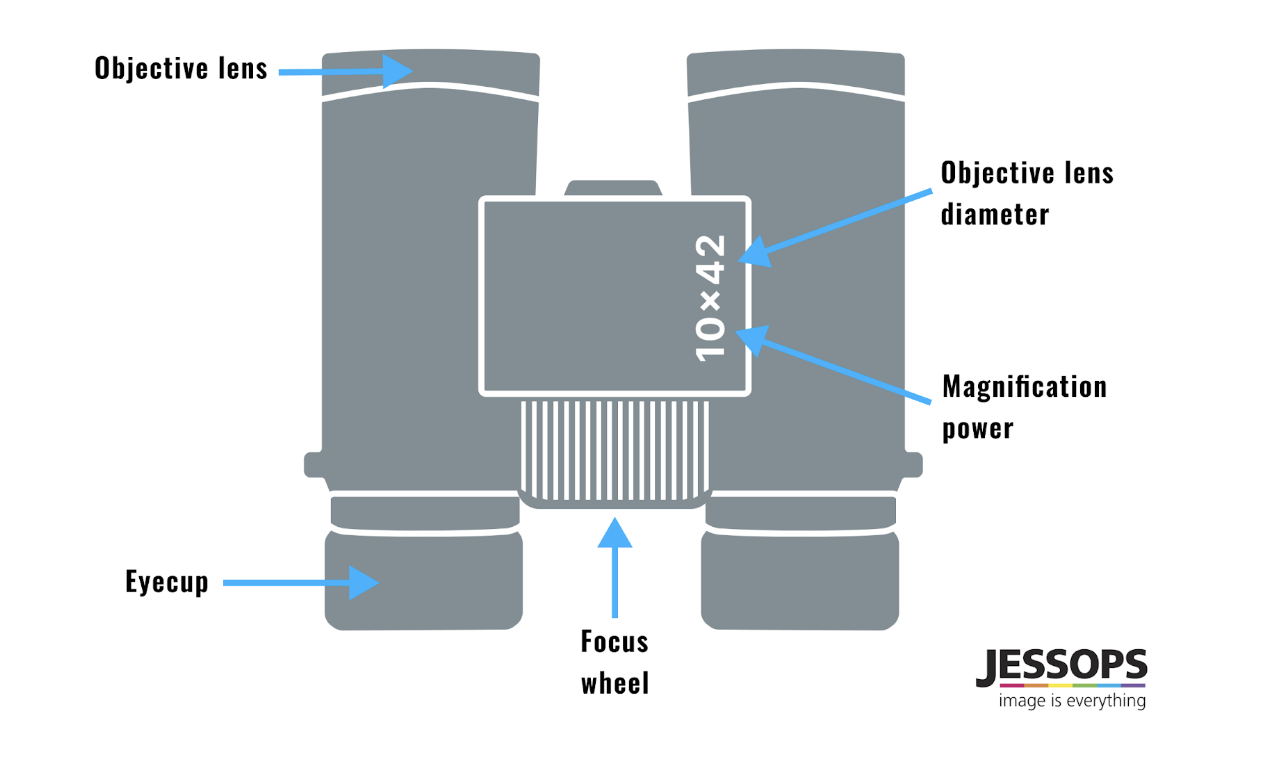
"You may have noticed numbers on the focusing wheel or central hinge of your binoculars,” says Lizzie. “These are key to choosing a brilliant pair.” But what do these numbers mean?
Let's say your binoculars are 10x42. The first number, 10, represents the magnification power. In simple terms, it means that when you look through these binoculars, objects appear ten times closer than they are to the naked eye. So, if you're watching a bird that's 100 feet away, it will appear as if it's only 10 feet away through the binoculars.
The second number, 42, is the diameter of the objective lenses in millimetres. These are the lenses at the end of the binoculars farthest from your eyes. The larger the objective lens, the more light the binoculars can gather, resulting in a brighter image, especially in low-light conditions.
"Here's the trick, though: bigger numbers aren't always better," explains Lizzie. "If you go for super high magnification, it can actually make things harder to see because the image might get shaky."
"So, think about what you'll use the binoculars for. For example, if you're observing fast-moving animals or sports, a magnification of up to 10x is usually good. However, for stationary activities like stargazing, 15x magnification would be a better choice to reveal those distant celestial details clearly."
Field of view
Field of view is the width of the area visible when you look through your binoculars — a critical factor to consider when selecting the right pair for your needs.
"Magnification power also has a direct effect on your field of view," explains Lizzie. "Simply put, the higher the magnification, the narrower your field of view becomes."
"A wider field of view allows you to take in more of the scene at once. This makes it easier to keep up with fast-moving subjects or survey a wide area without constantly adjusting your binoculars."
"On the other hand, if you're focusing on stationary subjects, like observing the details of a distant landscape, a narrower field of view might be acceptable. You're not tracking quick movements, so you can afford to sacrifice some width for increased magnification and image detail."
Information about the field of view when looking at binoculars will typically be stated as either:
-
Angular field of view in degrees (°) — This measurement describes the width of the observed scene in degrees through the binoculars. A larger angle indicates a broader view.
-
Linear field of view in feet at 1,000 metres – This measurement provides the width of the visible area in real-world terms. For example, if it states 120 metres at 1000 metres, it means you can see a 120-metre-wide area when you're 1000 metres away. It helps you understand the actual width of the observed scene in metres at a specific distance.
Objective lens diameter
"Objective lenses are at the front of the binoculars, the ones farthest from your eyes," says Lizzie, "Essentially, the larger the diameter of these lenses, the more light they can collect, resulting in a brighter and sharper image."
"In binocular specifications, you'll often find the objective lens diameter listed in millimetres (mm)."
"Choosing the right objective lens diameter again boils down to what you're using them for."
"If you plan on venturing out in darker conditions, a 50mm lens is excellent at gathering light, ensuring a clear view. But if you're mostly out in well-lit areas or during the day, a lower diameter, say 25mm, should do the trick."
Size
Lizzie says: "When choosing your binoculars size, think about what you'll be using them for and how much light you'll need. The size of the objective lenses significantly impacts your binoculars' physical dimensions and performance."
-
Compact (25mm or less) — "These are small and lightweight, perfect for when you want something easy to carry around," says Lizzie. "Think concerts, hiking trips, or even just stashing in your bag for a day out. They're super convenient because they won't weigh you down. However, just keep in mind that because they're more compact, they usually come with smaller objective lenses, typically around 25mm or less. This means they won't gather as much light, so they might not be the best for really dim conditions like stargazing."
-
Mid-size (30-42mm) — "These usually have slightly larger objective lenses, around 30mm to 42mm," explains Lizzie. "They strike a nice balance between portability and performance. So, these could be a great fit if you're into birdwatching or nature walks. They offer decent light-gathering capabilities and a comfortable viewing experience without being too bulky."
-
Large binoculars (42mm or more) — "With bigger objective lenses, usually 42mm or more, large binoculars are big and powerful. This means they can gather a lot of light, making them great for things like stargazing or observing wildlife in low-light conditions. But, they can be heavy and bulky to carry around, so they might not be the best choice if you're on the move a lot."
It's all about balancing size, performance, and what works best for you.
Exit pupil (brightness)
The exit pupil is the width of light leaving the eyepiece. If you hold the binoculars at arm's length and look through the centre of the eyepieces, you'll see it as a small circle of light.
It directly influences how bright the image appears, particularly in low-light conditions. Put simply, the bigger the exit pupil, the brighter the image will be.
You'll often see the exit pupil size listed in millimetres in binocular specifications. It's calculated by dividing the diameter of the objective lens by the magnification number. For instance, if you have 10x42 binoculars, the exit pupil size would be 4.2mm (42mm divided by 10).
-
Low-light conditions — “An exit pupil of 5mm or above is ideal for dimly lit environments,” says Lizzie. “This larger size ensures a brighter image, making it easier to see details.”
-
Daytime viewing — “When there's plenty of available light, the exit pupil size is less critical,” explains Lizzie. “However, most binoculars still have an exit pupil of 2mm or above, providing sufficient brightness for daylight observation.”
“If you anticipate using them in low-light situations, paying attention to the exit pupil size ensures you'll enjoy the best viewing experience possible.”
Eye relief
Eye relief refers to the distance between your eye and the eyepiece while still maintaining a full field of view.
"For those who wear glasses, a minimum of 11mm of eye relief is essential," explains Lizzie. "This ensures a comfortable distance from the eyepieces without pressing your glasses against them."
"Adjustable eyepieces are a common feature in many binoculars, allowing you to achieve the maximum eye relief specified in the product details. This adjustment is usually done by rolling down the rubber eyecups or twisting a collar to shorten the eyepieces."
Prism type
Prisms are crucial optical components in binoculars that help transfer light from the scene to your eyes. There are two main types of prisms used in binoculars:
-
Porro prism — "This is the older type of prism design," explains Lizzie. "Porro prism binoculars are wider and use angled prisms to direct light from the scene into centrally-placed objective lenses that you look into. Because the light is bounced through a couple of prisms before reaching your eye, porro binoculars often provide greater magnification and less light loss compared to roof prism varieties."
-
Roof prism — "Roof prisms are constructed from two straight tubes that lead directly to your eyes via a set of prisms. These binoculars are more common nowadays because they're smaller and lighter."
"Choosing between porro prism and roof prism binoculars depends on your preferences and needs. While porro prism binoculars may offer better magnification and less light loss, roof prism binoculars are more compact and light."
"However, advanced models of roof prism binoculars can provide just as good a view as porro prism binoculars. So, it's all about what you're looking for in your binoculars!"
The best binoculars for every occasion
Here’s our round-up of our recommended binoculars for every situation:
For birdwatching: Nikon Monarch M7 10x42 Binoculars
For horse racing: Nikon Sportstar Zoom 8-24x25 Binoculars
For travel: OM System 8x25 WP II Binoculars
Budget-friendly option: Jessops 10x25 Compact Binoculars MKII
for beginners: Nikon Prostaff P3 8x42 Binoculars
for long distance: Pentax SP 20x60 Waterproof Binoculars
Compact option: Pentax UD 9x21 Binoculars
How to choose binoculars for birdwatching
When it comes to choosing the best binoculars for bird watching, there are a few key features to keep in mind:
-
Magnification — "A magnification of 8 is ideal because it provides a good balance between zooming in on birds and maintaining a wider field of view," explains Lizzie. "This wider view makes it easier to find and follow birds without the image becoming shaky or unstable."
-
Portable design — "Look for binoculars that are fairly compact and easy to carry, especially if you'll be hiking to different spots to observe birds."
-
Water resistance — "Since you'll be venturing outdoors, it might be a good idea to choose waterproof binoculars to ensure they can withstand any unexpected rain showers."
- Fog resistance — "Select binoculars that won't fog up when transitioning from warmer indoor environments to cooler outdoor temperatures."

- Magnification: 10x
- Objective diameter: 42mm
- Exit pupil: 4.2mm
- Field of view at 1000m: 121m
- Eye relief: 16.5mm
- Weight: 680g
- Dimensions: 142 x 130 x 57mm
“The Nikon Monarch M7 10x42 Binoculars are some of the best on the market for birdwatching," says Lizzie. “With a powerful 10x magnification and wide 60˚ apparent field of view, they let you take in more of the scene at once — perfect for tracking birds in flight or spotting hidden wildlife.
“Combined with superb colour clarity and a lightweight, durable design, they’re an outstanding choice for birdwatching.”

"The rubber armour provides a firm grip and protects the binoculars against the elements. So, whether you're on a woodland walk or climbing a hill to get a better view, these binoculars are built to last."
"And there's no need to worry about a little rain or dew ruining your birdwatching experience. The Nikon Monarch M7 Binoculars are waterproof up to 1 metre for up to 10 minutes, and their fog-free design ensures clear views."
Want to put them to the test? Read our Guide on The 10 Top Best Locations for Capturing Wildlife.
How to choose binoculars for horse racing
Whether you're heading to the Grand National or your local track, a good pair of binoculars is a must-have for horse racing, especially if you're seated far away. Binoculars allow you to get closer to the action, providing a clearer view of the races and ensuring you don't miss any thrilling moments.
Here are the top features to look out for when choosing binoculars for horse racing:
-
Magnification and image stability — “Opt for a lower magnification between 7x and 10x, suggests Lizzie. This provides more control when following the fast-paced action of horse racing without your view becoming too shaky. Anything above 10x can interfere with the clarity of the image.”

- Compact designs — “When you're at the horse racing, you want binoculars that won't weigh you down, especially if you're making a day of it. That's where compact designs come in handy — they can easily slip into your pocket, leaving your hands free to hold your betting slip or your drink. Since most races happen during the day, you don't need massive optical lenses to capture the action. And thankfully, smaller lenses usually result in more compact and lightweight binoculars.”
-
Weather resistance — “You never know when a sudden rain shower might hit, especially in the UK. That's why it's essential to choose binoculars that can handle a little rain. Look for waterproof binoculars to ensure your viewing experience isn't dampened by unexpected weather.”
- Magnification: 8–24x
- Objective diameter: 25mm
- Exit pupil: 3.1mm (at 8x)
- Field of view at 1000m: 80m (at 8x)
- Eye relief: 13mm (at 8x)
- Weight: 305g
- Dimensions: 123 x 109 x 51mm
"The Nikon Sportstar Zoom 8-24x25 binoculars are a brilliant choice for horse racing," says Lizzie. "With their unique zoom lever, you can smoothly adjust from 8x to 24x magnification — giving you the flexibility to follow the fast-paced action and then zoom right in when you want to see your horse cross the finish line."
"Compact and lightweight at just 305g, they’re easy to carry all day and small enough to slip into a pocket or jacket. Plus, the multilayer-coated lenses ensure bright, clear images, so you won’t miss a single moment of the race."

The turn-and-slide rubber eyecups also make them comfortable to use for long periods, while the 10-year Nikon warranty means they’re built to last, race after race.
How to choose binoculars for stargazing
Lizzie says: "Stargazing with binoculars offers a more accessible and user-friendly experience, especially for beginners who might find telescopes a bit daunting."
Here are some key features to consider when choosing binoculars for stargazing:
-
Magnification of x15 or higher — "Opt for a magnification of at least 15x to observe stars and planets in detail. However, keep in mind that higher magnification can amplify hand-held shake, so it's best to use a tripod for steadier viewing."
-
Larger objective lens diameter — "Look for binoculars with larger objective lenses, ideally around 42mm or 50mm. These larger lenses gather more light, making them suitable for stargazing in darker environments where you need to see faint celestial objects."

-
Lens coatings — "Opt for binoculars with multi-coated or fully multi-coated lenses. These coatings reduce glare and improve light transmission, resulting in brighter and clearer views."
To learn more about stargazing, read our Beginner’s Guide to Astrophotography.
"If you're passionate about astronomy, the Pentax SP 20x60 Waterproof Binoculars are the ideal choice," says Lizzie.
"With their impressive 20x magnification and giant 60mm objective lens, these binoculars offer breathtakingly detailed views of the night sky. Stars appear brighter, and distant planets are easier to pick out—even in low-light conditions."
“But what really sets them apart is their durability. Pentax has added a protective nano-technology coating that repels water, oil, dust and dirt—perfect for nights when you’re out under damp skies or moving between different environments. Combined with a tough, rubber-armoured waterproof body that’s nitrogen-purged to prevent fogging, these binoculars are built to perform in any condition.”

“Inside, you’ll find fully multi-coated optics and BaK4 prisms with phase correction—technical touches that make a big difference when you’re stargazing. They help maximise light transmission, reduce glare, and deliver crisp, sharp images that make faint celestial objects easier to spot.”
"In short, these binoculars give you the power and clarity you need for stargazing, while also being tough enough to take anywhere.”
Want to find the perfect spot to test your binoculars? Read our guide on The UK’s Top 10 Stargazing Locations.
- Magnification: 8x
- Objective diameter: 25mm
- Exit pupil: 3.1mm
- Field of view at 1000m: 108m
- Eye relief: 15mm
- Weight: 260g
- Dimensions: 114 x 115 x 45mm
“I always recommend the OM System 8x25 WP II Binoculars for travel,” says Lizzie. “They’re incredibly durable and reliable, yet so lightweight at just 260g that you can slip them into your bag without even noticing the extra weight.”
With a waterproof, nitrogen-filled body and fogproof technology, they’re designed to withstand the elements, while the rubber coating provides a secure grip for peace of mind during outdoor excursions.

The foldable, compact design makes them easy to pack away, and with a close focus of just 1.5m, you can enjoy detailed views of everything from sweeping landscapes to nearby wildlife.
- Magnification: 10x
- Objective diameter: 25mm
- Exit pupil: 2.5mm
- Field of view at 1000m: 96m
- Eye relief: 11mm
- Weight: 295g
- Box dimensions: 125 x 113 x 63mm
“At just £19.99, these Jessops binoculars pack a real punch when it comes to value,” says Lizzie. “Despite their budget-friendly price tag, they don’t cut corners — offering 10x magnification for clear, detailed viewing and a rainproof design so you can head outdoors with confidence.”
“Compact and lightweight, they slip easily into your bag, making them perfect for travel or days out. With multi-coated optics that boost brightness and clarity, they’re a brilliant budget-friendly option for anyone who wants dependable binoculars without spending a fortune.”

- Magnification: 8x
- Objective diameter: 42mm
- Exit pupil: 5.3mm
- Field of view at 1000m: 126m
- Eye relief: 20.2mm
- Weight: 575g
- Dimensions: 152 x 130 x 52mm
"The Nikon Prostaff P3 8x42 Binoculars are an excellent choice for beginners", explains Lizzie. "The lower price point provides an accessible entry into the world of binoculars, perfect for those just starting out and not yet ready to invest in more advanced models."
“What makes them great for first-time users is their relatively wide field of view. It gives you a panoramic perspective, making it easier to locate and follow moving subjects like birds or animals with confidence.”

“Add in the comfortable turn-and-slide eyecups, rugged rubber armour and waterproof, fog-free design, and you’ve got a reliable, easy-to-use pair of binoculars that are perfect for anyone just starting out.”
- Magnification: 20x
- Objective diameter: 60mm
- Exit pupil: 3.0mm
- Field of view at 1000m: 38m
- Eye relief: 21mm
- Weight: 1400g
- Dimensions: 197 x 118 x 240mm
“If you’re looking for some of the best binoculars for long-distance views, the Pentax SP 20x60 Binoculars are hard to beat,” says Lizzie. “With powerful 20x magnification and large 60mm lenses, they pull in faraway detail with stunning clarity, making them perfect for spotting wildlife or scenic landscapes from a distance.”
“They’re also built to last, with a rugged, waterproof, nitrogen-purged body that stands up to the elements. Fully multi-coated lenses and BaK4 prisms ensure bright, crisp images, even in challenging conditions, so you can rely on them for exceptional performance wherever your adventures take you.”
- Magnification: 9x
- Objective diameter: 21mm
- Exit pupil: 2.3mm
- Field of view at 1000m: 87m
- Eye relief: 9.9mm
- Weight: 195g
- Dimensions: 87 x 108 x 38mm
“The Pentax UD 9x21 binoculars are one of the best compact options out there,” suggests Lizzie. “At just 195g, they’re incredibly lightweight and easy to slip into a bag or pocket, making them ideal for travel, concerts, and everyday use.”
“With 9x magnification and fully multi-coated optics, you get bright, clear views for the price, making them great value at under £70. But if you’re looking for extreme detail or long-distance performance, you may want to step up to a larger lens size. For portability and affordability, though, these are a good choice.”

Frequently asked questions
How do I use binoculars?
"Using binoculars may seem straightforward, but a few simple steps can greatly enhance your viewing experience," explains Lizzie.
-
Adjust the eye cups — Before using your binoculars, adjust the eyecups to the appropriate position. If you wear glasses, twist the eye cups down to accommodate them. If not, twist them up for a comfortable fit against your eyes.
-
Adjust the width — Hold the binoculars up to your eyes and move the barrels closer together or farther apart until you see a single, circular image instead of two overlapping circles. This ensures that both of your eyes are aligned with the binoculars.
-
Set the focus — Look through the binoculars with just one eye and find a distant object to focus on. Use the central focusing wheel (usually located between the barrels) to adjust the focus until the image is sharp and clear. Then, close that eye and use the diopter adjustment (usually a small dial on one of the eyepieces) to fine-tune the focus for your other eye.
-
Hold the binoculars steady — Keep them close to your eyes with both hands, and use your thumbs to support the barrels from underneath. This helps to maintain a stable view and reduces hand shake.
-
Adjust the focus for different distances — If you're viewing objects at various distances, use the central focusing wheel to adjust the focus accordingly. For example, if you're birdwatching and you switch from looking at a bird in a tree to one on the ground, you may need to readjust the focus.
-
Experiment with magnification — Binoculars often have a zoom feature that allows you to adjust the magnification level. Try different magnification settings to find the best view for your subject.
Lizzie says: "Just remember, if you've been viewing for an extended period, give your eyes a rest by looking away from the binoculars and focusing on distant objects with your naked eyes. This helps to reduce eye strain and fatigue."
How do I clean my binoculars?
Cleaning your binoculars is essential for maintaining clear and crisp images. Lizzie explains how to do it:
-
"Remove dust — Start by using a soft brush or air blower to remove any dust or debris from the lenses and the body of the binoculars. This helps prevent scratching the lenses during the cleaning process.
-
Wipe clean — Next, gently wipe the lenses with a microfibre cleaning cloth. Avoid using your shirt or other fabrics, as they may contain particles that could scratch the lens coatings. If there are stubborn smudges or fingerprints, lightly moisten the cloth with a few drops of lens cleaning solution or water. Avoid cleaning products designed for your glasses or windows, as this can damage the lens coating.
-
Remove remaining dirt — Use a lens cleaning brush or a lens pen with a soft brush tip to remove any remaining dirt or smudges from the lenses. Be gentle and avoid applying too much pressure, as this could damage the delicate lens coating.
-
Clean the body — For the eyepieces and the body of the binoculars, you can use a damp cloth or a mild soap solution to gently wipe away any dirt or grime. Be sure to dry them thoroughly afterwards - especially if your binoculars aren't waterproof to prevent damage.
-
Put them back in your case — Finally, store your binoculars in a protective case when not in use to keep them clean and free from dust and debris."
Why are some binoculars with similar specifications more expensive than others?
"Binoculars with similar specs can vary in price due to differences in build quality, materials used, and brand reputation," explains Lizzie. "Higher-priced binoculars often use premium materials for the lenses and prisms, like high-quality glass and advanced coatings. This results in better image clarity, brightness, and durability."
"Renowned brands may also command higher prices due to their reputation for superior optics and customer service."
How to focus binoculars?
Look through the binoculars with just one eye and find a distant object to focus on. Use the central focusing wheel (usually located between the barrels) to adjust the focus until the image is sharp and clear. Then, close that eye and use the diopter adjustment (usually a small dial on one of the eyepieces) to fine-tune the focus for your other eye.
What do the numbers on binoculars mean?
The numbers on binoculars, for example, 10x42, refer to the magnification and objective lens diameter.
Magnification (the first number) — In 10x42, the '10x' means objects will appear 10 times closer than they do with the naked eye. Lower numbers like 7x give a steadier image, while higher numbers like 12x+ bring you closer.
Objective lens diameter (the second number) — In 10x42, the '42' is the size of the objective lens in millimetres. Larger lenses (like 50mm+) gather more light, giving brighter images, especially at dawn or dusk. Smaller lenses (like 25mm) make binoculars more compact and lightweight.
When were binoculars invented?
Binoculars have a fascinating history, dating back to the early 17th century. The exact origins are a bit unclear, but they are believed to have been developed independently by several people around the same time.
Hans Lippershey, a Dutch eyeglass maker, is often credited with inventing the first telescope in 1608, which laid the groundwork for binocular technology. However, the credit for the inaugural binocular telescope, designed to be used with both eyes simultaneously, typically goes to J. P. Lemiere, who crafted one in 1825.
Over the centuries, binoculars have undergone significant advancements, evolving into the versatile optical instruments we use today.
Shop binoculars at Jessops today
At Jessops, we have a wide range of binoculars from leading brands like Nikon, Penatax, Vanguard and Celestron.
If you're looking for more advice and inspiration, check out our blog. If you have any questions or you're unsure about which product is right for you, contact us today.
Sign up for our latest news and offers
Receive the best offers right to your inbox by signing up to our newsletter
Thank You
